

![National camp action [P]...](https://skitrax.com/wp-content/uploads/2019/08/Duluth-4-2019-08-08-at-10.46.51-AM.png)
![Matt Liebsch on the CXC Elite Team [P] CXC...](https://skitrax.com/wp-content/uploads/2019/08/Matt-Liebsch-CXC.2-525x700.4.jpg)
![Dan LaBlanc [P]...](https://skitrax.com/wp-content/uploads/2019/08/Dan-LaBlanc-img_1855.3.jpg)
 November 2, 2009 (Ried im Innkreis, Austria) – The last time that I was in Austria was 1991 and I never thought that I would ever see it again. However, I was lucky enough to win a contest that was put on by Fischer in Canada to visit their factory in Ried and to ski on the Dachstein Glacier.
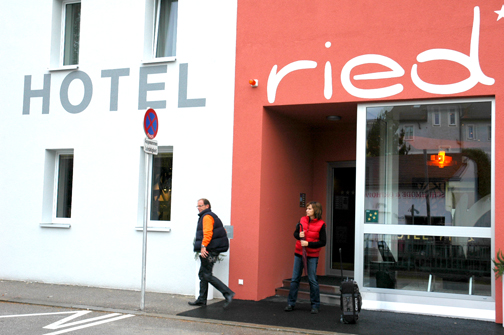
I traveled to Austria with Dave Fabbro, the retail manager of Hardwood Ski and Bike. We were met in the Munich airport by a representative from Fischer and after a wait of an hour or so we were joined by Simon Cousineau from Pecco’s in Ottawa and Ron Metza, the owner of Stussi’s in Vernon, BC. After two hours of driving in the rain we were in Ried im Innkreis, the world headquarters for Fischer. Following a good sleep in a traditional Austrian Gasthaus we were ready for a day of presentations and a tour of the Fischer facility.
The country, as one Austrian told us, is a land of farmers. There’s a total population of 8 million with 1.5 million living in Vienna. The next largest cities are Lienz and Graz at 300,000 and then there are four or five cities of around 70,000 including Ried. It’s the center of the area called Innkreis in the northeastern part of Austria about an hour from the Czech border and besides industries like Fischer, it services the surrounding farms and small towns. It’s also the gateway to the lake district of Austria and every Friday night the local roads are full of people from the cities heading to their cottages – kind of like the 400 in Southern Ontario.
The first thing that you notice about Austria is that it is very clean. There’s no garbage on the side of the road and all of the fields and farms looked almost manicured. The second thing you’ll observe is that there are no fences around the farms and properties. The result is a country of great beauty, regardless of whether you are in the mountains or the rolling hills of the farming areas.
Ah, the mountains! The Austrian Alps are some of the most beautiful mountains in the world and for us they had a special treat – new snow in October. When the sun came out the views were spectacular.
Fischer employs over 600 people in their Ried factory and another 500 in a satellite factory in Mukachevo, Ukraine where they make touring and wood core skis. They also have a part ownership in Loeffler, a sports clothing manufacturer and a very good working relationship with Wintersteiger, a company that makes stone grinding machines and machinery for agriculture. Both of these companies also have their headquarters in Ried.
Our first morning was spent in presentations about Fischer and the business of cross-country skiing. Fischer, like all of the other ski companies in the world, has been hard hit over the last few years by the lack of snow in Europe and the slow down in sales of cross-country skis worldwide. Since 2004 the sales of cross-country skis has fallen 15% world wide with Fischer having a market share of 30% – the highest in the business.
Canada sits in the middle of the sales ladder with about 63,000 pairs sold per year – a far cry from the boom years in the 70s and 80s when there were up to 1.4 million pairs sold per year. The largest market in the world is Russia with almost 800,000 pairs sold per year followed by Norway at 284,000, Finland at 171,000 and the US with 120,000.
Fischer’s goals are to continue to be the #1 company in skis and to continue their dominance in racing, especially on the World Cup. This is very important to all of the ski companies, especially in the European markets where a win at the World Cup on a Sunday can translate into a spike in sales on Monday in ski shops. They also want to continue to lead the industry in ski production technology and do it within the budget structure that is mandated by the static market for skis.
Fischer has also stepped into the boot business in cross-country. A couple of years ago they terminated their relationship with Salomon and switched to NNN by Rottefella. During this time NNN has gone from a 30% market share to a 60% market share, mostly because of this new relationship.
Fischer’s goal is to become #1 in cross-country ski boots as well and to do this they have hired orthopedists and boot experts to help them make their boots better. They’ve decreased the weight of their skating boots and t now have very good skating and classic boots that can rival any other boots in the market.
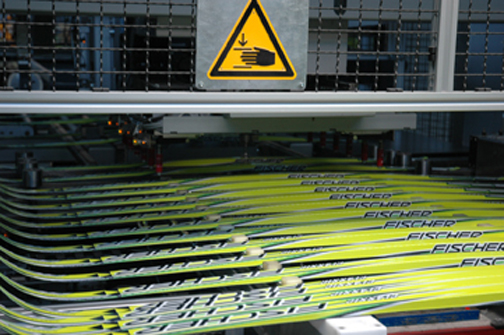
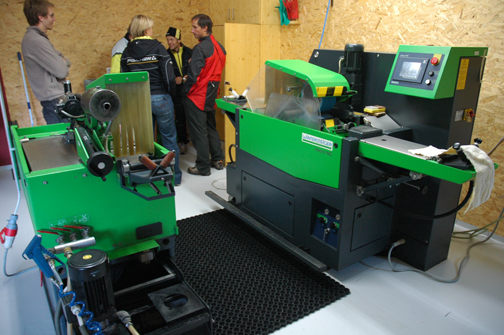
A tour of the factory in the afternoon was very enlightening. We saw the production of cross-country skis from the start to the finish. The most impressive part of the tour was the new machine that they’ve recently put into production that allows them to perfectly match a pair of skis. This machine cost 400,000 Euros and will hold 200 pairs of skis in its memory and can then perfectly match each ski for pre-load, residual camber and expressiveness force by taking measurements every 2 mm down the length of the ski.
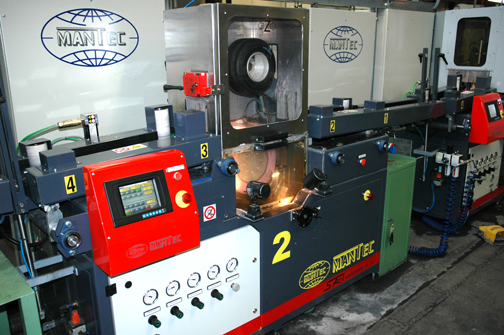
Another equally impressive set of machines were the four huge industrial stone grinders that put a perfect finish on every base. The first grinder took off all of the dirty base material and the last three put in the structure that would match the camber of the ski for cold or plus skis.
This winter Fischer is using two molds in their racing skating skis to create camber. The #115 is for hard tracks and is very stable and good for the consumer. The #610 is for softer tracks and it is the one that is used the most by World Cup skiers. The reason for this is that these skiers ski more on a flat ski that is pointed straight ahead for speed and spend less time with the ski on edge. They don’t need the stability as much and because they also ski right on top of their feet they find this type of ski faster.
For Classic skis Fischer is using three cambers. The 81 or 812 (depending on whether it is a Carbonlite or RCS ski) is a new camber for classic that Fischer has developed. It is an “on-off” camber that is softer to close in the middle but it is stiffer at the start of the grip pocket. This camber will not close fully under full kicking pressure when you are on one ski, but they believe that this ski will glide better. The 90 camber is lower when you place it beside the 812 because the tip and the tail of the ski are softer. This ski will open up at the tips and tails when you squeeze them together and is great for soft tracks especially in spring skiing conditions. Racers use this ski more than the consumer because it’s easier to swing the ski forward and set the wax, but it is less stable.
The third camber is available only on the ZERO ski. This ski is a non-waxable ski that will only work well in 0 degree or plus conditions. The camber is lower and more balanced in the middle so it is easier to kick without grip wax. You rough up the base with sandpaper to make this ski grip.
Much of the work that is done in research and development for Fischer skis is done by Hans Hubinger. He is the acknowledged expert in ski construction, cambers and structure. Every ski that Fischer produces starts in his lab as an idea and ends there for testing. The new “hole” ski, with an egg-shaped hole in the ski tip, is the latest product of their ongoing research. This ski has a much lower swing weight in the tip making it faster for skating, especially in hard conditions.
We visited Hubinger in his lab after our return from the Dachstein Glacier. As well as talking to him about the construction of the skis and the camber we also spent some time discussing stone grinding and base structure. Fischer has been a business partner with Wintersteiger for years and they have developed a set of base structures that have been tested to work in all snow conditions.
Each of these structures have been tested extensively in the field by racers, service men and coaches. On our first morning in Ramsau at the base of the Dachstein Glacier we visited the “office” of Michael Grossinger who is the head of racing service for Biathlon and Nordic Combined for Fischer. Grossinger’s “office” is housed in the Kobaldhof, a local hotel and contains two Wintersteiger stone grinders, eight stones, a waxing bench, a kitchen table that doubles as a desk, hundreds of pairs of skis and posters signed by all of the top biathletes and cross-country skiers in the world. It is here where the Fischer racers come to have their skis ground by the best. Grossinger is a former biathlete with tremendous energy and passion for what he does. While he would not tell us his secrets he did show us some skis that he had been working on. Each of them had a different structure for different snow conditions and all of the skis looked very fast.
One interesting piece of equipment that he had was an air driven clamp for his ski bench. A press of a button opened up the clamp and another closed it. I’ve got to get myself one of those! No more fighting with clamps on bindings or ripped knuckles. No more iron cords caught on a clamp.
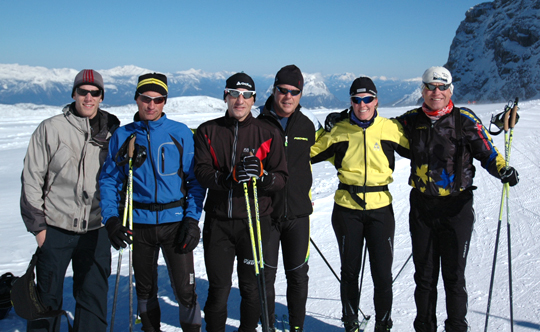
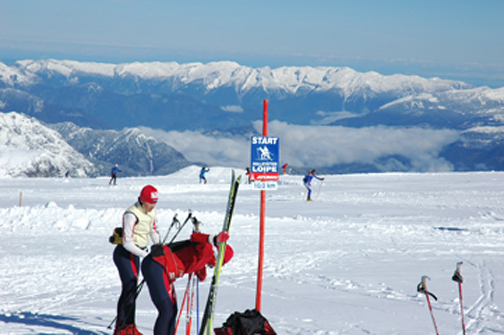
Next up was the Dachstein Glacier. The last time that I had been to “der Dachstein” was in 1991 and I was interested to see how it had changed – especially to see how much smaller it was with the climate change. However, the night we arrived it started to snow and it snowed for over 24 hours. On our first ski after our visit to Grossinger we went up in the afternoon and skied in a blizzard. Not only could I not see the edge of the Glacier, I couldn’t see the person skiing 10 yards in front of me. It was great snow, though, and a lot of fun to ski. (later I was told that the glacier has receded a lot in the past 20 years, so much so that it had to be closed in July and August this year.)
The next day dawned clear and cold and we went up again for a full day of skiing. The temperature was below 0 and it was a perfect day for classic skiing. The only problem was the wind. It was very strong and blew in the tracks. We were still able to ski over three hours, and it was great to be on snow again.
What has not changed is Ramsau. It’s still a picture postcard town in the Austrian Alps that would make a perfect location for a winter or a summer holiday. There are many hotels and traditional Gasthaus options at reasonable prices. You can ski on the glacier, hike in the mountains, ride your bike or ski on the same ski trails that hosted the 1999 Nordic World Ski Championships.
That night we drove back to Ried. The next day we went on tours of the Fischer Composite Technology (FCT) facility (the FCT division has since been sold and is no longer part of the Fischer portfolio) and the Wintersteiger factory before we spent some critical time shopping in the Loeffler factory outlet store.
The last day of our trip was a free day. Dave and I rented some mountain bikes and went for a long ride in the Austrian countryside. Austria is full of marked, paved bike routes and hiking trails. The bike path that we rode on wound its way through rolling fields and small towns and villages. It was a perfect fall day and it was one of the best rides that I have ever had. If you are looking for a place to ride on a holiday, think of Austria – it was fantastic!
The whole trip was extremely well organized by the staff of Fischer Canada and Fischer Austria. We were greeted warmly by everyone and treated like kings for a week. We all learned a great deal about Fischer skis and boots and the company – information that will help us to serve our customers better this winter. I felt very important as a Fischer Racing Center dealer and this trip showed me why Fischer is the #1 ski brand in the world – because they take care of their customers at the highest level.