![National camp action [P]...](https://skitrax.com/wp-content/uploads/2019/08/Duluth-4-2019-08-08-at-10.46.51-AM.png)
![Matt Liebsch on the CXC Elite Team [P] CXC...](https://skitrax.com/wp-content/uploads/2019/08/Matt-Liebsch-CXC.2-525x700.4.jpg)
![Dan LaBlanc [P]...](https://skitrax.com/wp-content/uploads/2019/08/Dan-LaBlanc-img_1855.3.jpg)
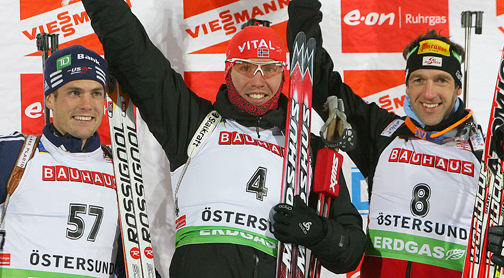
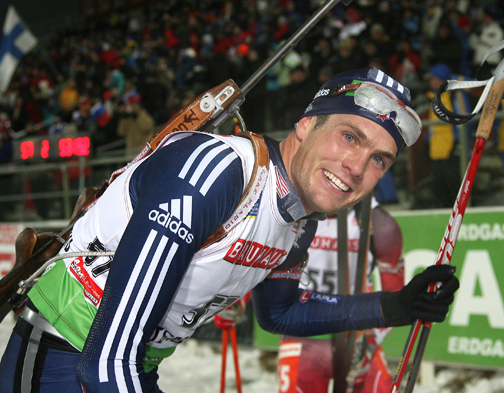
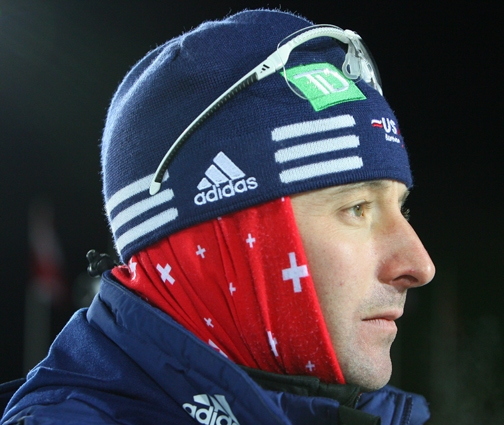
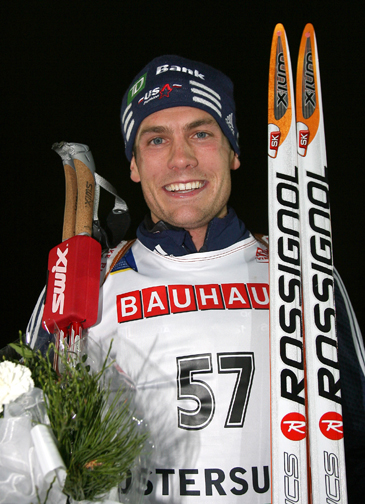 December 3, 2009 (Östersund, Sweden) – How does one go from an outside Olympic medal hopeful to true medal contender? A realistic display of the ability to win a medal is a good place to start. American biathlete Tim Burke did just that on Thursday. After a bunch of top ten finishes since the 2006 season – a season in which he failed to score even a world cup point – Burke has slowly been clawing his way to the top of the this wildly popular European sport that is dominated by the athletes from that continent.
Today’s performance was something of a different color for the rising star, who has had a number of top 10s since 2006, but never anything better than 6th. This was a day that the word “potential” became reality and was shaken from the 27-year-old’s back.
Burke hit the course among the leaders and stayed there, leading much of the race at the time checks, and never cracked with crowd of more than 4.000 spectators following the exciting race. He never looked close to it. Leading the standings going into the final shooting stage where each miss adds a minute to the ski time, Burke had been perfect out of 15 shots taken. In a calm steady rhythm, he was unmoved by a missed third shot. The final two targets flipped white in cadence without Burke even blinking.
In a sport full of if-only’s and could-have’s, Burke could have won. He came awfully close. But so did twenty other guys. That’s biathlon. Yet, this was groundbreaking for Burke personally in context to winning a medal in Vancouver – something he and the US program have spoken about plenty. Staring down the United State’s first ever World Cup win, the first win of the season, the gold World Cup Overall Leader’s bib, and a host of ground-breaking mojo – all in the first big race of the season and the jitters that come with it – it’s particularly important to note that Burke stayed calm and shot well in that final shooting stage. Potentially, he could have done what he did today in each of the last three seasons – but he didn’t. A critical detail when stating you want medals at the Olympic Games. Today’s performance makes an Olympic medal for Burke infinitely more attainable than it was yesterday.
“It gives me a lot of confidence,” said Burke as he described how this first podium finish prepares him for the Olympics come February. “Today was an important step to get on the podium. It goes a long way to help my confidence going into Vancouver because I know I have been on the podium before,” he added.
He’s had a history of falling slightly ill at times in the past several seasons, and the training plan coach Per Nilsson creates for Burke has seen small adjustments from recent seasons to maintain health. “We didn’t do anything special in training (coming into Östersund) like we did in other years. We just kept doing the good training that is making me fit.”
Nilsson, who took over the team reins following the 2006 Torino Olympics, was “not surprised” with Burke’s performance today. “Yeah, you never know where you are because you know the other teams are training hard too,” said Nilsson, “but it was not surprising. This is a very competitive sport. To get to this level takes time. This is a well deserved performance.”
Burke has utter faith in his trainer. “Before 2006, I never scored a World Cup point,” said Burke. “The year I started working with Per, I was 25th overall in the world by the end of the year.”
Burke’s towering physical performance today was key, but it was his shooting that most obviously buoyed him in tying the American high water mark on the World Cup – equaling Josh Thompson’s 1992 second place in the men’s 20km in Ruhpolding, GER, just prior to the Albertville Olympics. Recent USBA hire, Armin Auchentaler of Italy, was brought on this spring to raise the team’s performance on the shooting range. “We’ve changed little things but nothing too important,” said Auchentaler. “We have just focused on making them faster on the range without misses.” The understated affect of Auchentaler was obvious watching Burke today.
The US Biathlon Team has been less than subtle about their intentions in Vancouver. Medals are expected which some would say is heady for a program that can boast only one top-10 at the Games, and no World Cup wins. But lack of past success hasn’t deterred the focus of those tasked with the job. If Jeremy Teela’s third place finish at the pre-Olympic World Cup in Vancouver last March was a premonition, today’s performance by Burke was an emphatic stamp on the program’s momentum.
“This is the best finish ever by a U.S. Biathlete,” states US Biathlon Association Executive Director, Max Cobb. Cobb has been with the program since 1990. “With all due respect to Josh (Thompson), who was an amazing athlete and incredible competitor, the level out there today with the popularity of the sport and how professional it has gotten; we just couldn’t have dreamed how hard it would be to win today, back in those days.”
Burke, Cobb, Nilsson, and Auchentaller were all quick to cite a team effort with a success like today. The momentum of the program, according to Cobb, stems from several factors, including restructuring the US Biathlon Board of Directors in 2006, a substantial increase in support from the US Olympic Committee since Torino, and being “able to hire the best coaches and high performance leadership. We’re a much more professional organization.”
A cynic might say Burke lost his chance at a World Cup win today with a miss in the final stage. But clearly Burke finally showed what he’s capable of, and has been aiming to achieve as a top level biathlete. This is the first World Cup Tim Burke nearly won, but it won’t be the last. He went from a hopeful to a contender with today’s performance, and the U.S. Biathlon Team and the Olympic medals they talk about just got a whole lot closer.
Full results here.
Results (brief)
1. Emil Hegle Svendsen (Nor) 52:43.7
2. Tim Burke (USA) 53:19.2
3. Christoph Sumann (Aut) 53:33.2

- News
- BLOGS
- Adele Espy
- Alberta World Cup
- Alex Harvey
- Cailtlin Compton
- Craftsbury Green Racing Project
- Devon Kershaw
- Drew Goldsack
- Haley Johnson
- Holly Brooks
- James Southam
- Jessie Diggins
- Johnny Spillane
- Kikkan Randall
- Liz Stephen
- Lowell Bailey
- Perianne Jones
- Reese Hanneman
- Sadie Bjornsen
- Stefan Kuhn
- Tim Burke
- Torin Koos
- Videos
- Destinations
- Interviews
- Calendars
- Galleries
- Gear
- Racing
