![National camp action [P]...](https://skitrax.com/wp-content/uploads/2019/08/Duluth-4-2019-08-08-at-10.46.51-AM.png)
![Matt Liebsch on the CXC Elite Team [P] CXC...](https://skitrax.com/wp-content/uploads/2019/08/Matt-Liebsch-CXC.2-525x700.4.jpg)
![Dan LaBlanc [P]...](https://skitrax.com/wp-content/uploads/2019/08/Dan-LaBlanc-img_1855.3.jpg)

.2.jpg "Wynn Roberts, Battle Lake, MN[P]US Biathlon")
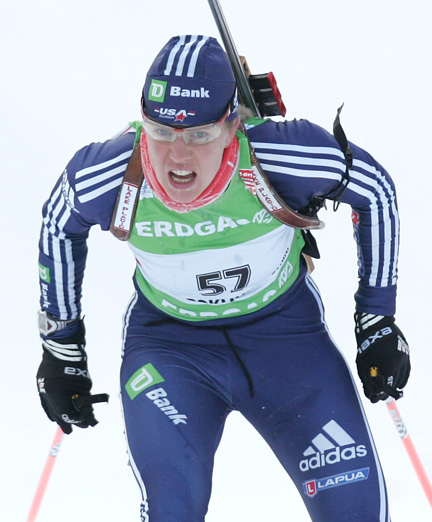

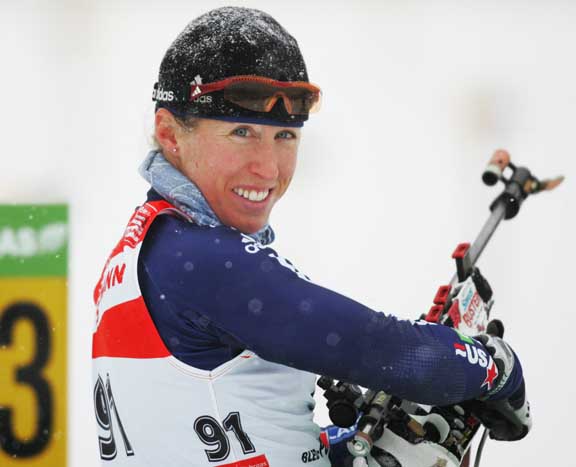
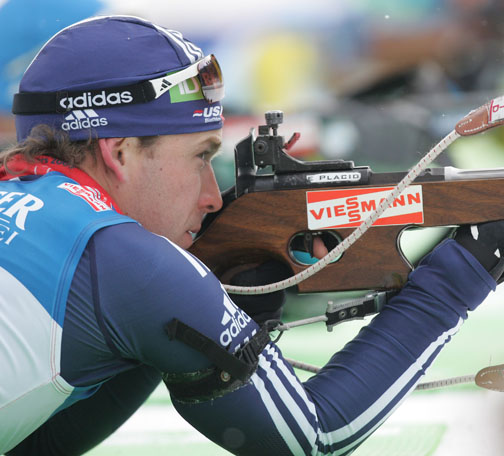
 January 13, 2010 – With all the excitement in the US Biathlon camp centered Sunday on Tim Burke’s yellow world cup leader’s bib at the fourth world cup stop of the season in Oberhof, Germany, a couple hours down the road in Altenberg, the remainder of the 2010 US Olympic Biathlon Team was being decided at IBU Cup #4 in Altenberg.
Burke, of Paul Smith’s New York, and Jay Hakkinen of Kasilof, AK, each secured their spots on the 2010 team with two top 15 finishes in 2009 World Cup action. Jeremy Teela and Haley Johnson each did so with top-30 finishes at the December World Cup in Pokljuka, Slovenia, just prior to the New Year’s break. In Teela’s case, it was the final of three possible pre-qualification spots.
With three of five spots taken from prequalification for the men and one of four for the women, two spots for the men and three spots for women remained to be decided in Altenberg. World cup veteran, Lowell Bailey of Lake Placid, and Kevin Patzoldt (Grand Rapids, MN), both earned their berth to the final trials in Altenberg by qualifying for the December World Cups. Wynn Roberts (Battle Lake, MN), Zach Hall (Nikiski, AK), Leif Nordgren (Marine on St. Croix, MN), and Walt Shepard (Yarmouth, ME), moved on to the Altenberg trials, through an IBU Cup trials series held by the USBA in Grand Rapids, MN, in late December.
Lanny Barnes (Durango, CO) and Sara Studebaker (Boise, ID), also December world cup racers, had to meet in Altenberg to hold off charges from Laura Specter (Lenox, MA), Susan Dunklee (Barton, VT), Tracy Colliander (Durango, CO), and Beth Ann Chamberlain (Grand Rapids, MN), who also qualified in Minnesota to have a shot at the roster.
The US team staff held a mid-week Olympic Trials men’s 10km and women’s 7.5km sprints, won by Bailey and Studebaker respectively. In the IBU Cup sprint, Bailey distanced himself from the trials field finishing 9th overall in the IBU Cup, way ahead of Kevin Patzoldt, who was the only male besides Bailey qualifying for the pursuit Sunday — the final trials race. In the women’s sprint, it was Lanny Barnes who edged Spector by 16 seconds and all women qualified for the pursuit for a final showdown on Sunday.
With Bailey solidly on the team, it came down to whether Patzoldt could score a big points race against Bailey, starting 2:12 behind, while the rest of the men had to sit out and await their fate. The time behind for Patzoldt was simply too insurmountable, and nearly nothing changed in the rankings with his pursuit effort. Essentially, the men’s trials came down to the first two sprint races, and when that shook out, it was Bailey and Roberts who came out on top.
The women didn’t even get a chance to race it out as the IBU Cup women’s pursuit was cancelled. The rules for cancellation stipulated the winner of each of the two trials races be nominated, meaning Studebaker and Barnes qualified, and the final spot was discretionary. Spector was the next-highest point earner, and the USBA nominated her in the final spot.
On Tuesday, the United States Olympic Committee introduced the 2010 US Olympic Biathlon Team to the media — a team full of experience and youth. Hakkinen returns for his fourth Olympic Team, Teela for his third, Burke, Bailey, and Barnes each for their second. The remainder of the team members are first-time Olympians.
While the spirits are high for the entire team, the buzz clearly revolves around the men’s team, “the most competitive (American) Olympic team ever,” according to World Cup overall leader, Tim Burke.
“We all want to be the first American to win an Olympic medal (in biathlon),” said the veteran Hakkinen. In Torino, he missed the opportunity to that title by the narrowest of margins in the 20km individual, posting the second fastest ski time, but missing 3 of 20 targets, each miss carrying a minute penalty. His final miss was nearly a hit; what people in the sport call a split bullet. The miss cost him the bronze medal and relegated him to 10th place, still an American-best at the Olympics.
Now Hakkinen has to compete with a hot Burke for that honour. “Having Tim (leading the World Cup standings) is a huge confidence boost… especially in the relay. But we all have a chance in the individual events too,” continued Hakkinen. The only problem Hakkinen joked, was that Burke is “not leaving much for the rest of us to do,” meaning Burke is setting program firsts faster than anyone else on the team can challenge him for those honours.
Burke entered the season a dark horse for an Olympic medal, but with three podium finishes already this season in World Cup competition — the only three of his career — Burke found himself in the yellow overall leader’s bib by the end of the third World Cup. Last Sunday in Oberhof, Burke battled tough shooting conditions and a full World Cup field, to finish 2nd in the 15km mass start, after an 18th place in the sprint on Saturday lost him the yellow bib to Russia’s Evgeny Ustyugov.
With Ustyugov finishing 4th to Burke’s 2nd, Burke slid back into the lead Sunday. “I thrive on being the underdog,” said Burke, though his consistency so far this season has now arguably put him among the favorites in Vancouver, and made him the backbone of a relay team with real medal potential. “We recently got our new Adidas team suits for the Olympics, and they are turquoise,” said Bailey. “But with your teammate wearing the yellow bib, you can still feel a sense of pride wearing a turquoise suit into the stadium. He gives us all a new sense of pride, wearing the same suit as (the best guy in the world).”
On the women’s side, Lanny Barnes is the only athlete with previous Olympic experience. Since Torino, it is Haley Johnson, however, who has taken the competitive lead for the US women, finishing 23rd at last year’s World Championships, and more recently 21st in Pokljuka, to pre-qualify for Vancouver. Johnson and the rest of the women’s team want to improve on their 10th place finish in last year’s World Championship relay, a goal Barnes said is achievable, particularly with their familiarity with the venue. “It’s definitely a huge advantage for us. It’s like having a home field advantage.” Barnes edged her twin sister, Tracy (Colliander), for a spot on this team. “Of course it was difficult (on me), but I will be representing her as much as the United States and this team.”
Studebaker and Spector have been teammates before as collegiate skiers at Dartmouth College, where Spector still balances college and training for biathlon. “Dartmouth’s trimester system has allowed me to take classes in the spring and summer so I can train and compete in the fall and winter.” Dartmouth has a long history of placing athletes on the US Olympic Biathlon team under former coaches, Al Merrill and John Morton.
Current coaches Cami Thompson and Ruff Patterson clearly have helped that tradition along with Studebaker and Spector going to Vancouver. “I don’t think we’re particular helpful since we don’t really know how to coach biathlon,” said Thompson, who with Patterson, helped lead the Big Green to the 2007 NCAA Skiing Championship title. “What we do have is an open mind to help our skiers think beyond college skiing and what they need to do to train (at a higher level). When there are opportunities to work on the (shooting) range, or to train for biathlon, we have created the flexibility for them to do that.”
The team is now together in Ruhpolding, Germany, site of World Cup number 5, and will be together from now until the Olympics. “We all start working together (now),” Burke said of the team being named. Hakkinen, who led the Olympic relay at the first exchange to Burke in Torino, said that relay was just “an omen to what we will do in Vancouver.”
With Burke and Bailey much more experienced, and a renaissance of sorts in Jeremy Teela who finished 3rd in the men’s 20km individual at the World Cup test event last March in Whistler, the team has the experience today that they lacked to maintain the relay lead in Torino.
The US Biathlon Team is suddenly capturing the imagination of the American media as the potential Cinderella story for the US Olympic team in Vancouver. Biathlon Executive Director, Max Cobb, cites the US Olympic Committee’s “willingness to invest” in the program since Torino as the primary catalyst to the current situation.
A greater investment led primarily to “the best coaching staff in the world, for our team,” according to Cobb. His sentiment is a common thread in the statements of the athletes. Head Coach Per Nilsson has worked wonders since taking over in the spring of 2006, and recent hire, Armin Auchentaler of Italy, has improved the teams shooting performance.
“He breaks the shooting process down into pieces, we work on the pieces, and he puts them all back together for us for a better overall performance,” according to Hakkinen. Burke attributes his increased success this season compared to those of the past couple, to an increased shooting speed and consistency; something he credits Auchentaler with.
Perhaps the most obvious characteristic of the group with less than a month before the Vancouver Games, is that the US Biathlon Team is clearly just that — a team. With Burke, Hakkinen, Teela, and Bailey on the roster, first time Olympian, Wynn Roberts, will have little chance to get a start in Vancouver, as each nation can start only four athletes in each event.
Perhaps he summed up the team effort best saying, “I hope these guys have great races and there’s no need for me (to start).” No statement was more selfless and indicative of the group focus by the US Biathlon team to win the country’s first Olympic medal in the sport.
2010 US Olympic Biathlon Team
Men
– Tim Burke, Paul Smiths, NY
– Jay Hakkinen, Kasilof, AK
– Jeremy Teela, Anchorage, AK
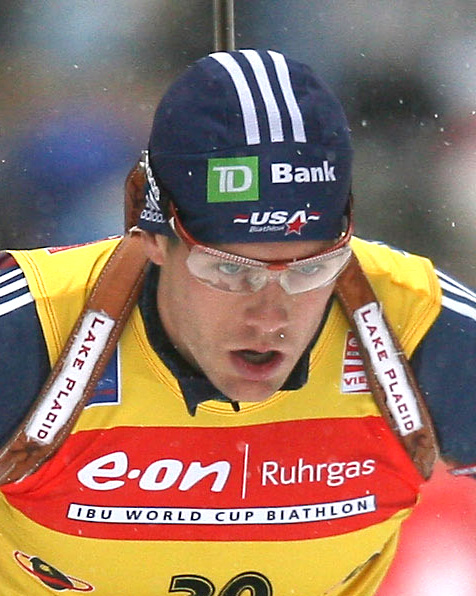
– Lowell Bailey, Lake Placid, NY
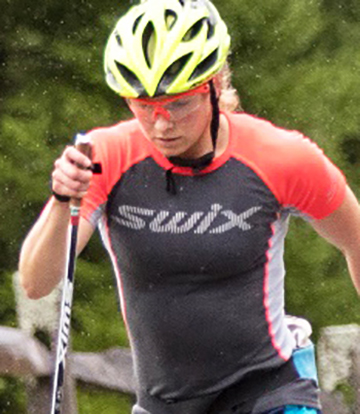
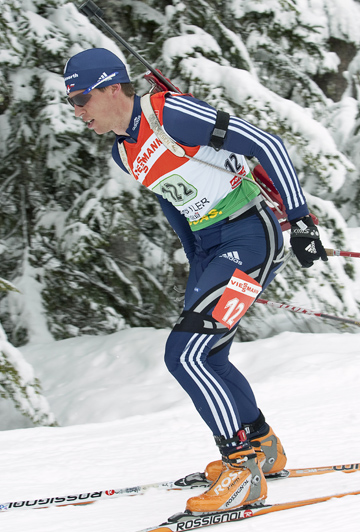
– Wynn Roberts, Battle Lake, MN
Women
– Haley Johnson, Lake Placid, NY
– Sara Studebaker, Boise, ID
– Lanny Barnes, Durango, CO
– Laura Spector, Lenox, MA

- News
- BLOGS
- Adele Espy
- Alberta World Cup
- Alex Harvey
- Cailtlin Compton
- Craftsbury Green Racing Project
- Devon Kershaw
- Drew Goldsack
- Haley Johnson
- Holly Brooks
- James Southam
- Jessie Diggins
- Johnny Spillane
- Kikkan Randall
- Liz Stephen
- Lowell Bailey
- Perianne Jones
- Reese Hanneman
- Sadie Bjornsen
- Stefan Kuhn
- Tim Burke
- Torin Koos
- Videos
- Destinations
- Interviews
- Calendars
- Galleries
- Gear
- Racing
