
![National camp action [P]...](https://skitrax.com/wp-content/uploads/2019/08/Duluth-4-2019-08-08-at-10.46.51-AM.png)
![Matt Liebsch on the CXC Elite Team [P] CXC...](https://skitrax.com/wp-content/uploads/2019/08/Matt-Liebsch-CXC.2-525x700.4.jpg)
![Dan LaBlanc [P]...](https://skitrax.com/wp-content/uploads/2019/08/Dan-LaBlanc-img_1855.3.jpg)

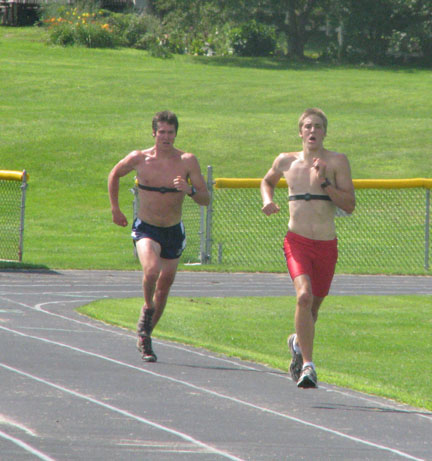
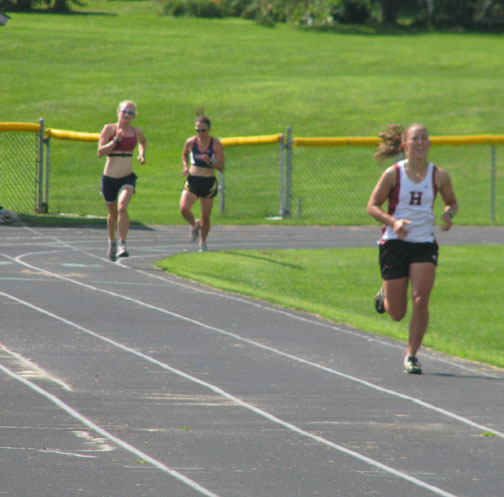
 August 13, 2009 – Last Thursday morning, our team prepared for a workout we had been dreading all week: 2-minute intervals on the track. In rollerskiing or trail running workouts, you have to pay attention to how you place your ski or your foot to adjust to terrain. On the track, the only thing you are concerned about is speed. Matt says, “I love the track because it’s so easy to go hurt.” You place your foot exactly the same way with every step, and you shouldn’t have to think about it.
I think that many skiers dread the track because they don’t know how to how to place that foot, or, more generally, how to run on the track: they have extraneous, inefficient movements or incorrect body position.
For instance, Hannah runs exactly the same on any surface. On a track, her form doesn’t do her any favors, even though she can beat me handily running up a hill in the woods. Tim has good upper body position and Matt does the right thing with his legs, so Pepa joked that if you combined them, you’d have a perfect track runner. (Matt and Tim both ran plenty fast, so this might be irrelevant)
I dread the track for a different reason. My form probably isn’t better than Tim or Matt’s, but it’s decently efficient because I trained on the track for two unfortunate years in college. I was a terrible college runner, running slower and slower in every race compared to my high school times and quitting after my sophomore fall. In track workouts, I have a hard time focusing. It seems like I can’t push aside memories of those disastrous workouts on the Dartmouth track. Ollie concluded that I have “track PTSD.”
In any workout, when you tire, your form starts to fall apart. On a track it is more obvious and you feel yourself slowing. As Lauren says, “I find it frustrating because when I go really hard, everything falls apart and I feel like I’m being lazy.” But, according to Pepa, it’s not being lazy. Rather, it’s a neuromuscular problem. There’s nothing you can do about it except focus on having better technique. For me, this falling-apart is usually followed by an emotional one: that feeling, of running slower and slower, reminds me of specific bad races and workouts, and I hate it.
And the less I run, the more often and quickly my form breaks down in a workout. Now I’m rollerskiing more than I ever have before, but only running once or twice a week. My neuromuscular memory for running isn’t as strong as it used to me. Ironically, it takes fewer intervals before I start feeling like I’m running poorly, even though my added fitness means that I can maintain the cardiovascular effort longer than I could before.
I went into Thursday’s workout determined not to let this stupid emotional crap get the better of me.
The first two intervals felt great. I was running fast and relaxed, feeling like maybe I belonged after all. With each added interval, though, I could feel my form disintegrate: I no longer felt relaxed, my stride shortened, I began trundling instead of loping, and my shoulders hunched up.
I tried to focus on fixing these form problems instead of the fact that I was falling apart. I thought about picking up my knees, about using my arms at the end of each interval, about keeping my face loose instead of grimacing. It’s the same strategy you should use in a ski race if you feel like you are skiing poorly: focus on fixes rather than getting discouraged. I was still the same amount ahead of Hannah, who was the same amount ahead of Lauren; none of us were falling apart more than the others. This helped me keep my head together.
Although I almost lost it on the seventh of eight intervals –I felt myself trundle slower and slower and momentarily lost focus – I made it through to the end. We all did, suffering separately but together, and embarked on a cool-down jog around the trails at People’s Academy, where Hannah had raced so many times.
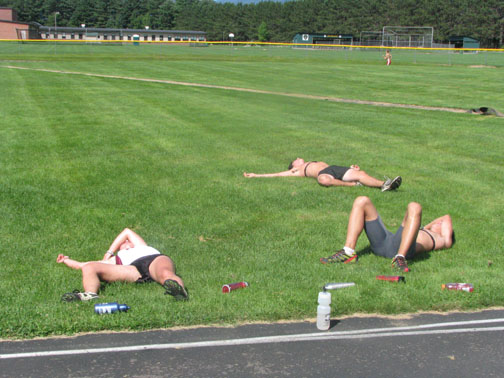
Afterwards, we sat in the grass watching the boys finish off their workout, stretching and sipping on our recovery drinks. The sky was blue, the sun was out, and it seemed like a pretty good day after all. We sensed that we had already accomplished something even though it was only 11 a.m.
Although I certainly hadn’t moved too quickly – 2 minute 600’s are not impressive – I felt good about the intervals. I didn’t conquer all the demons but I made a start. It was almost ‘just another workout’ instead of something to get worried about.
As we left, we hoped that we wouldn’t be returning to the track anytime soon. But at the same time, we knew that someday we’d get to do the workout again, and, no matter whether we had dreaded today not, many of us are looking forward to it.
As Lauren says, “I want to do the workout again to try to do better, because on the track there’s no excuses. You go hard and that’s it. You could probably always go harder. The track won’t lie. “

- News
- BLOGS
- Adele Espy
- Alberta World Cup
- Alex Harvey
- Cailtlin Compton
- Craftsbury Green Racing Project
- Devon Kershaw
- Drew Goldsack
- Haley Johnson
- Holly Brooks
- James Southam
- Jessie Diggins
- Johnny Spillane
- Kikkan Randall
- Liz Stephen
- Lowell Bailey
- Perianne Jones
- Reese Hanneman
- Sadie Bjornsen
- Stefan Kuhn
- Tim Burke
- Torin Koos
- Videos
- Destinations
- Interviews
- Calendars
- Galleries
- Gear
- Racing
