![National camp action [P]...](https://skitrax.com/wp-content/uploads/2019/08/Duluth-4-2019-08-08-at-10.46.51-AM.png)
![Matt Liebsch on the CXC Elite Team [P] CXC...](https://skitrax.com/wp-content/uploads/2019/08/Matt-Liebsch-CXC.2-525x700.4.jpg)
![Dan LaBlanc [P]...](https://skitrax.com/wp-content/uploads/2019/08/Dan-LaBlanc-img_1855.3.jpg)

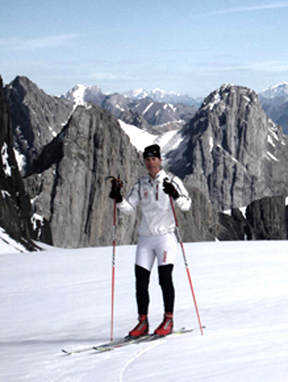 August 1, 2008 (Squamish, BC) – Amy Caldwell is in her second year as the head coach of the Callaghan Valley Training Centre (CVTC), in Squamish, BC. Prior to coaching at the CVTC, Caldwell coached at the Stratton Mountain School in Vermont for 12 years. To her credit she has coached more than ten athletes that represented the USA at the World Junior Championships, some of whom have gone on to become members of the US Ski Team and US Olympic Team.
You’re on year number two as Head Coach of the Callaghan Valley Training Centre (CVTC). How has the transition been from coaching at the high school level at Stratton Mountain to coaching full-time skiers at a national level?
Amy Caldwell: It has been a great opportunity for me and a really exciting challenge. To be honest, the athletes I was coaching at the 16-20 year old range at SMS were quite similar to the athletes I am seeing now. Sverre Caldwell and I worked hard to develop a pipeline at SMS that started in the Bill Koch League (equivalent to the Jackrabbit program in Canada). From there, we tried to “cherry pick†the best potential from the two nearest Bill Koch programs in the area and try to convince their parents that coming to SMS full-time was a really good idea starting in 9th grade (there were winter-term programs for 7th and 8th graders). I think we did a very good job doing this and the results of SMS show this.
In Canada, it has been a shift working with a lot of athletes that are older and lack the serious training background. Last year, I came in with the intention of going to a new level with my athletes, but a lot of them were not ready for this. This year, I have been a little more conservative in my approach, so I am hoping this will lead to better results for the athletes.
Your husband Zach relocated his very successful ski service business (Caldwell Sport) to Squamish, BC, to be closer to the 2010 Olympic site. Tell us about the move and what was enticing for you and your new job position.
AC: The decision to move to the 2010 venue was definitely a joint decision. We had both been doing extremely well in Vermont, but we both felt that a move to the Olympic venue could be a once in a life time opportunity. For Zach, that meant following his erudite love of pursuing the ultimate grind or ultimate wax job (or in the case of the Callaghan, the ultimate “hairy†preparation). For me, the training centre concept was very appealing. I think it helps a lot to have like-minded individuals working hard toward a common goal. I know I would have loved a similar opportunity if there had been one way back when.
Coaching in cross-country skiing is male dominated as in most other sports. In Canada you’re one of three women in head coach position at the provincial/national level. What’s it going to take to see more women coaching in the sport? Are there barriers along the way?
AC: From my perspective, I don’t really see gender as a big issue. Growing up, I had a lot of great coaches along the way and many of them were female. In college, Patty Ross was one of my ski coaches at Middlebury and I really looked up to her. This was probably one of the reasons that I actually thought of ski coaching as a viable career. Hopefully, other strong women will start to recognize coaching as a good occupation option as well. I think strong role models are the key to seeing more women in coaching.
How have you settled in to life on the west coast? Have you noticed changes in Squamish with 2010 getting closer?
AC: It has definitely been a great opportunity to see the Olympics coming to a specific area. It has been impressive to see the amount of resources and energy that goes into an Olympic venue. The amount of construction and design that has gone into the Cross Country Venue and highway has been amazing. For example, there are 77km of trails (already) at the Callaghan and there are more trails being built this year. (The skiing at the Callaghan goes from late October until the middle of June.) My only hope is that Callaghan catches on as a cross-country destination so that more people come to ski the trails. For instance, we had a camp for the first week of June at the Callaghan with more than 30km of skiing and we were virtually the only ones skiing on the trails. We need to attract more skiers to this area in the off-season.
Also, it has been totally amazing to have the best skiers in the world coming to the Callaghan for ski camps prior to the Olympics. I only wish every Canadian could take advantage of this. This is huge! There is nothing better than skiing and talking with the best skiers in the world.
You’ve had the chance to coach in the both the US and Canadian systems. Are there differences or similarities that stood out to you right away?
AC: It has definitely been very interesting and I am still trying to come up with the best of all possible worlds. I think Marty Hall has spoken about some of the differences and I think those comments are worth revisiting. From my point of view, one of the strengths that I see in Canada is a very strong coaching education system. This has both good and bad. I think the material presented is awesome, but having to take all the appropriate courses may present some barriers to some very good potential coaches that feel that their time may be better spent. It’s all about social incentives. Why spend time taking coaching courses when they can take other courses and make real money? That said, if a person really wants to pursue coaching in Canada, there are a ton of opportunities right now.
In the US, there is no real coach’s education, yet they have some amazing coaches. I think the US has really headed the right direction with the help of Pete Vordenberg. He has made huge strides in galvanizing the top US coaches and has really made every club feel like a part of the bigger system. This is incredibly important, especially in a system with a fairly limited budget and a large geographic area to cover.
I think if you could combine Canada’s coaching education with the US sense of camaraderie and every one working for the greater good, that would be the best of all possible worlds.
Have you had some Vermont maple syrup sent out to you while in Squamish?
AC: Funny you should ask. Zach’s uncle has been a big (relative to Putney, the real syrup capitol of the world of course) sugar maker in Vermont. This is his final year in operation and we are trying to figure out what to do. We only have a few half gallons left.
How has it been living in Canada? Do you have a favourite Canadian beer yet?
AC: It has been really great living in Canada and meeting a ton of new people. We feel privileged to be here and have enjoyed the Olympic spirit. Our son is already sure he is Canadian. As for the beer, it seems pretty good. What do you recommend?
Keep sampling… and thanks for taking the time to answer these questions from up on the Haig glacier and all the best.
AC: Thank you.

- News
- BLOGS
- Adele Espy
- Alberta World Cup
- Alex Harvey
- Cailtlin Compton
- Craftsbury Green Racing Project
- Devon Kershaw
- Drew Goldsack
- Haley Johnson
- Holly Brooks
- James Southam
- Jessie Diggins
- Johnny Spillane
- Kikkan Randall
- Liz Stephen
- Lowell Bailey
- Perianne Jones
- Reese Hanneman
- Sadie Bjornsen
- Stefan Kuhn
- Tim Burke
- Torin Koos
- Videos
- Destinations
- Interviews
- Calendars
- Galleries
- Gear
- Racing
