![National camp action [P]...](https://skitrax.com/wp-content/uploads/2019/08/Duluth-4-2019-08-08-at-10.46.51-AM.png)
![Matt Liebsch on the CXC Elite Team [P] CXC...](https://skitrax.com/wp-content/uploads/2019/08/Matt-Liebsch-CXC.2-525x700.4.jpg)
![Dan LaBlanc [P]...](https://skitrax.com/wp-content/uploads/2019/08/Dan-LaBlanc-img_1855.3.jpg)
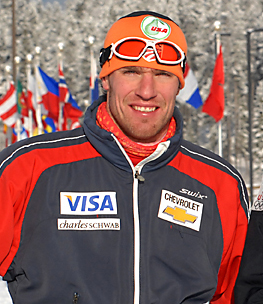 December 3, 2008 (Davos, Switzerland) – Torin Koos is a member of the US Ski Team and is traveling in Europe for the first period of the World Cup. We caught up to him via email and at his hotel in Davos, just after racing to a 35th placing at the World Cup XC Sprint in Kuusamo, Finland. Koos races on Rossignol skis, boots and bindings, and Exel poles. His web site and blog are found here.
How are things going in Europe – are you adjusted and ready to race? Tell us about the routine to get firing on all cylinders overseas?
TK: The trip to Europe has been solid. The team is in good spirits and racing well which makes spending time in places like Gallivare (Sweden) or Muonio (Finland) that much better. Unfortunately, after a week over here I picked up a virus in my lungs and spent a full week out of commission and a couple more days skiing really, really easy. Less than ideal for racing, especially on the World Cup – but we’ve all been there. Now I’m on the way back and have two weeks until the Davos (Switzerland) World Cup. That’s enough time to get in a good training stint and find the perfect feeling for speed on snow.
How is everyone else on the USST holding up?
TK: Everyone is pretty solid. Kikkan [Randall] just scoring her first distance points ever is excited – she is having a great start. [Kris] Freeman told me yesterday that he just had his best two season-opening races, so we’re all excited about his solid start as well. Andy [Newell] is in the mix, [Chris] Cook has two distance races under 60 points, so obviously he’s fit and getting ready to go. I guess I’m the only one who isn’t living up to expectations [laugh].
You just finished 35th at Kuusamo, how do you feel about thatresult?
TK: I raced as well as my body is up to. I don’t want to make excuses, but my body just hasn’t been capable of racing fast [after being sick]. Being 0.3 seconds out of qualifying, given the circumstances, is solid. When the time is right I’ll get the results and be able to go for it. I just need to get back on track and I have time to do it. Kuusamo is a great place for me and it was disappointing to not deliver there, but each season is different and I have to deal with it and adjust. It is one of the hardest sprint courses out there, so I was hoping to come out of this with some points to help with my overall WC ranking, but that’s the way it goes.
What are your big targets for 2008-2009 and how are you preparing for them?
TK: The Nordic World Champs in Liberec (Cze) for sure. Also the Canadian World Cups in Whistler. These will be the only real chance before the big show [Olympics] to race a world-class field on the Olympic course.Finally, I look to finish the season with my best ever end-of-season world ranking. My current best is 19th and I’d like to finish in the top ten this year.
What lies ahead for you in the early part of the season?
TK: After the races here in Davos I will head over to Dusseldorf (Germany) for a sprint and sprint relay (Dec. 21-22) with Andy and Kikkan. Following Europe I will head back to the Washington where I’ll have another two-week block to prepare for the Whistler World Cups.
With two weeks until Davos, what will you do in terms of training and preparation?
TK: I’m in full-on training camp mode here. Today I did a 3-hour ski this morning and then strength training in the afternoon. You definitely can’t neglect training this early in the season and it is important to not only ski fast in December, but in February and March. World Championships are a big focus and the Olympic course World Cups are obviously the big targets, so we have to prepare for those races.
It’s hard to balance training, travel and racing and still peak at the key events. How do you confront this challenge?
TK: One of the great things is that I have the points to jump into World Cup distance races now. Racing is a great way to build fitness and getting in a couple of 10km and 15km races will definitely boost capacity and race training. I also have to select periods during the year when I can put in a little more emphasis on training. That’s why I’m not hitting any other races now, so I can focus on Davos. I’m skipping Swiss Cup races, a city sprint in Grenoble (France), and World Cup races in La Clusaz (France) to focus on training and preparing for Davos and my bigger objectives. I will do the same thing later in the season – skip the US XC Nationals so I can focus on some solid training blocks to prepare for the Nordic Worlds and the upcoming World Cups on the Olympic courses.
How do you train or prepare in the few days leading up to these smaller objectives?
TK: Leading up into races, I’ll cut the really long distance down to no more than 1.5-hour sessions once or twice per day. The intervals get shorter with shorter work sessions. Two days out I’ll take it super-easy.
How has the snow been over there this season?
TK: Snow has been marginal in Europe the last few years, almost to the point of disbelief. So far this year has been great. We’ve had natural snow in Kuusamo and Gallivare and we have at least a meter to a meter-and-a-half here in Davos, so there is tons of great skiing in Scandinavia and the Alps.
Have you noticed any increased crowds at the races due to the good snow?
TK: That is tough to say. I do know that there was an incredible amount of people out skiing on the trails in Davos today. I probably skied by about 1,000 people just hanging out there and getting their langlauf on.
Since we’ve been here, we got about 10 inches of new snow and the Alpine skiing looks incredible. I hope to swindle a half day on the mountain.
That’s the biggest thing I’m looking forward to outside of training and racing while I’m here.
What’s the off-snow event or trip you’re looking forward to the most this year?
TK: Last year I spent a week alpine skiing in Vail following the season. This year I’m thinking of heading to a little more coastal climate. I’m still very close to my former college roommate. He lives in Santa Barbara. He’s always telling me I have to visit his family in the Santa Ynez wine grotto. I’d also like to learn about sailing. After the season ends, you can probably find me at the Santa Barbara Yacht Club working on my ocean cruising skills.
Following your great distance results last spring at the US Distance Nationals do you see a future in distance racing?
TK: For the first time since 2005 I finished the World Cup last year outside the Red Group (top-30 world ranking). This was a little frustrating as I knew I didn’t put together my best days over in Europe so I had a little extra motivation at the end-of-season distance races. Over the last years I haven’t done many non-sprint races. I’d like to do more. On the World Cup, though, you have to have a sub-60 FIS point race to earn a start spot. Getting this sub-60 race was the #1 goal this spring. I picked up this result during the Canadian national championship 50km. It’s an aspiration of mine to race the relay for the U.S. at major championships. I also have a big desire to race the 50km at the 2010 Olympics. When my days on the US Team racing sprints comes to an end, I’ve promised myself to compete one year, hitting a couple of the World Loppets. I’ll go into the Marcialonga, the Vasaloppet, and see what I can do in this other side of the sport.
You recently moved your base to Bend, Oregon – how has it been so far?
TK: I moved to Central Oregon this past spring and I’ve soon come to know what I suspected – Bend is the ideal place to be a ski racer. I skied on the crust around Broken Top through the third week of June. I get to work on a near daily basis with my coach Justin Wadsworth. This fall, Lars Flora left Alaska to come down and train in Oregon with me. Great terrain. Great training milieu. Great training partner. Great coach to work with. What more do you need?
You started working with Justin earlier this year. What has this brought to your training?
TK: I started working with Justin this spring. He comes from an interval-based block training approach and I felt like that was what I needed: that high-speed red-line training. I had solid endurance and fitness, but I need to be able to hang in the pain cave and survive through the key moments in a race where the intensity is overwhelming. I had done certain types of training with Vidar [Loefshus, US Ski Team Sprint Coach] and then Chris Grover [USST Sprint Coach, following Loefshus]. They both laid a great foundation, but I was not the best skier in the world and so I thought I should try a new approach.
What are the big changes you’ve made other than the emphasis on intensity blocks? Any surprises…?
TK: The relationship with Justin has been great. I’ve changed quite a bit with strength. I do a lot of max strength now followed by contrast strength. The contrast strength uses light weight but fast movements. This makes me more focused in the weight room and allows me to spend less time
there and put more energy into pure skiing.
You graduated with a mass communications degree and do a lot of writing. Where do you hope to go with it?
TK: I get asked this often. My patent reply is, “to become a Pulitzer-prize worthy investigative reporter for the New York Times.” Will this happen? I don’t know. It’s hard to say what doors my motivation for journalism will open when the time is right. Maybe I’d love living and working in the Big Apple. Then again, I’m a Western boy. It would be hard for me to leave the Cascades or the Rockies behind. Writing is my outlet. Some people play video games with their free time. Some spend hours on the telephone with a significant other across the pond. I just happen to prefer the challenge of playing with the rhythm of words to tell a story.
Tell us about your volunteer work with In The Arena and the 5th grade class in Washington.
TK: I work with my junior high running coach, both in the classroom with his 5th graders and the junior high cross-country and track teams when I get the chance to get back to Washington. Working with fifth, sixth, seventh and eighth graders is pretty cool – the kids are in a pretty unique arc of their development. To see someone begin to find their passion, then help them channel this, is the favorite part of my time with In The Arena .
Who are strongest sprint teams on the World Cup right now and why?
TK: The best sprint teams are the usual suspects. The Germans, the Swedes and the Norwegians. The Canadians can be good, too. I might be biased, but I see no reason why the US will not put a team on the line in the near future that can go toe-to-toe with any of them. The first chance to prove this is Dusseldorf on Dec. 22. After this, the World Champs in Liberec.
Sprint racing can involve new names in the mix of winners. Do you adjust strategy based on who is in your heat?
TK: There are so many variables that if you try to plan it too much, you run into more problems than you solve. Now I have an idea of places on the course where my talents might allow me to do something – whether moving up in the pack or breaking away – so I just try to play out the course to my abilities. That said, sometimes, you adjust to people who you know are really fast in certain sections and try to hang on or catch a ride. For example, Andy [Newell] and [Bjorn] Lind are really fast accelerators and you know to watch out for that and try to stay on their tails. There are other guys who are really strong double-polers and you know to get on that train when they go. There are definitely guys you don’t want to follow on the downhills [laugh].
I’ve done some stone grinding on your skis. What’s your take, is the US competitive with other countries in skis, waxing and grinding?
TK: I’ve been on the US Ski Team for eight years now. The service team we have this year is the best I’ve ever been a part of. A group of real good guys with knowledge that are easy to communicate with that don’t mind long hours huffing in fluorocarbons in the wax cabin. They will be a part of any and all the success the US Team has.
Thanks Torin, good luck in the next few weeks.
TK: Thanks, great to talk with you.

- News
- BLOGS
- Adele Espy
- Alberta World Cup
- Alex Harvey
- Cailtlin Compton
- Craftsbury Green Racing Project
- Devon Kershaw
- Drew Goldsack
- Haley Johnson
- Holly Brooks
- James Southam
- Jessie Diggins
- Johnny Spillane
- Kikkan Randall
- Liz Stephen
- Lowell Bailey
- Perianne Jones
- Reese Hanneman
- Sadie Bjornsen
- Stefan Kuhn
- Tim Burke
- Torin Koos
- Videos
- Destinations
- Interviews
- Calendars
- Galleries
- Gear
- Racing
