

![National camp action [P]...](https://skitrax.com/wp-content/uploads/2019/08/Duluth-4-2019-08-08-at-10.46.51-AM.png)
![Matt Liebsch on the CXC Elite Team [P] CXC...](https://skitrax.com/wp-content/uploads/2019/08/Matt-Liebsch-CXC.2-525x700.4.jpg)
![Dan LaBlanc [P]...](https://skitrax.com/wp-content/uploads/2019/08/Dan-LaBlanc-img_1855.3.jpg)


 January 17, 2010 (Gatineau, QC) – The Way I See It! will be a part of SkiTrax’s new web site on a regular basis passing on my thoughts, opinions, and ideas as to how I see Nordic skiing’s direction now, and in the future. Of course this may require me to look at the past sometimes as history always has a story to tell. So, let’s get started.

The Big 5-0
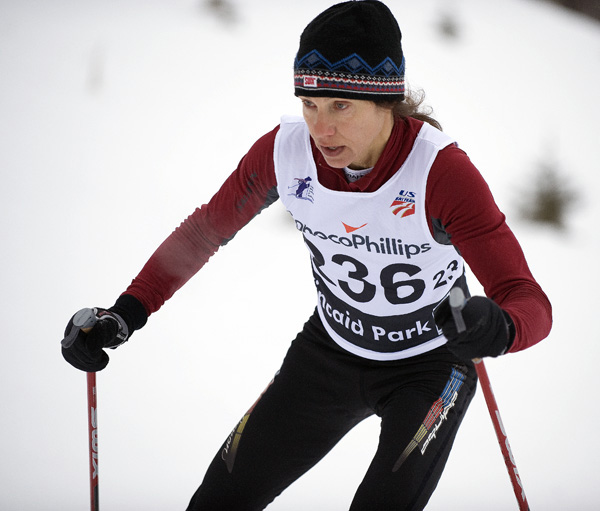
I was very surprised at how little attention was paid to the performance of Beth Reid at the short course US XC Nationals in Anchorage a week ago. Maybe it was because many don’t know her maiden name, Heiden, is one of the more famous names in the sports of speed skating, bike racing, and xc skiing from back in the 70s and 80s. Just the fact that she has turned 50 this past September should have turned heads more than it did. She’s the Dara Torres of xc skiing for sure.
In a 2-3 year period starting in 1979 she won the all-around World Speed Skating Championships (winning all four events), won a bronze medal in the 3000 meters at the 1980 Lake Placid Olympics, that summer won the World Road Championship in cycling, and three years later won the NCAA Championships having just taken up cross-country skiing two years previous. There is no way to check or compare, but I would be willing to bet this is one of the greatest demonstrations in endurance sport success ever. This is some athlete!!
At the Nationals, Beth had her best result in the freestyle sprints, the first event of the championships, with a 6th place; and followed that with an 8th place in the 10km free; then had a 17th place finish in the 20km classic race. All of this while being a mother to her up-and-coming bright young skier Joanne, who qualified in Anchorage for the first time for the US World Junior Championship team.
In ending, I can’t tell you how many Hall of Fame’s Beth is a member of, but I have a feeling it would take at least 10 fingers to list them all. This lady has left one big imprint everywhere she has been and is a real hero to a lot of women endurance athletes.
And here’s why she’s so good – she has continued training and racing as a training mate for her daughter as they live in Palo Alto, CA more then 60 miles from snow and anyone else to train with. Beth says they sure cover a lot of miles on their roller skis!
Canadian National Team Member Gone Missing??
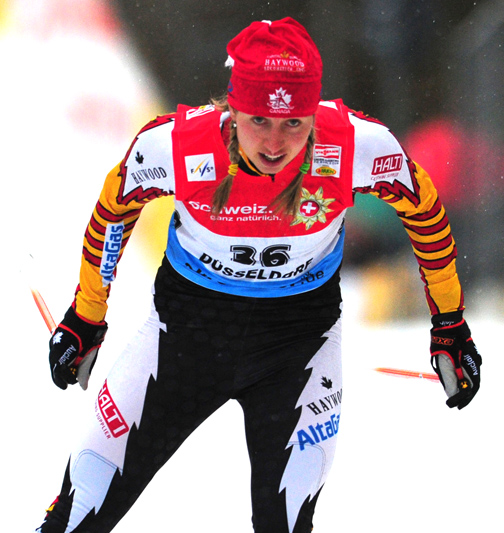
Canada is missing one of its more famous female cross-country skiers. She was last seen leaving Europe in mid-December after having had a fairly successful first re-engagement with the World Cup circuit, having missed all of last year’s calendar due to leg injuries and associated complications. Where has Chandra Crawford gone? I have scoured the results of all races held in Canada and the US since her return, but she hasn’t raced since coming back from Europe over a month ago that I can find.
I’ve seen a picture of her showing off her new Fischer ski boots that seem to have helped her finally get on top of her ankle and lower leg problems that she’s had to deal with for an extremely long period of time. She was sick when leaving Europe, but I would think she would be healthy and wanting to race now in her preparation for Vancouver. Racing at the Haywood NorAm on Dec 19-22 would have been out of the question, but not to race at the Haywood NorAms at Val Cartier on Jan 2-5 seems like some pretty important races to be missed.
In my mind, to get to the next level, Chandra needs to have raced these past weekends as she is now way behind the World Cup level of fitness that all of the other racers are now carrying into their next training period to get ready for the Olympics. If she waits to compete at real races at the Canmore World Cups (Feb. 4-7), the week before the Olympics, it will be too late. And I don’t see a lot of races on the Canadian calendar of any importance in the coming weeks.
Definitely not many Chandra vibes coming out of Canmore that indicates she is going to be race ready for Vancouver – I hope she can prove me wrong. I know she is one talented lady, and when fit, I think she is the best skating sprinter in the world, but it has been a long time since she’s shown that talent.
Let’s all keep our fingers crossed that she is found soon, because it looks like fellow Canuck, Dasha Gaiazova, is going to be a very,very strong international team mate for the team sprint.
Our Big Problem in North America
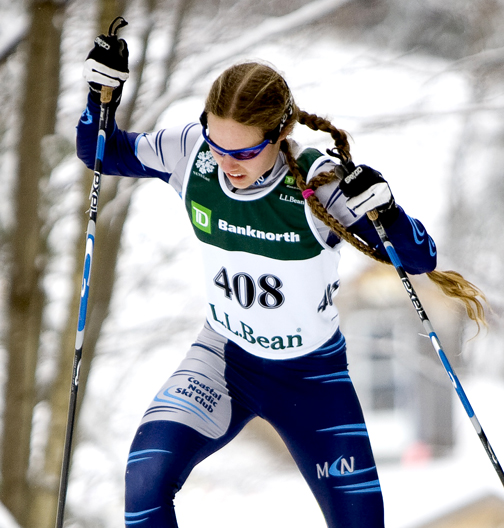
When I started working with Adele Espy, of Freeport, Maine, at the end of her junior year in high school, she was training about 315 hours as far as she could tell. She wasn’t keeping a real training log, yet, so this number could be higher, but it also could have be lower and as she told me, 15 of those hours were horseback riding! Hmmmm! So, for her senior year, trying to get her closer to the hours she needed to be doing to get on an international track she went to a 500-hour year. Then this past year, Dick Taylor, her training/technique coach (and myself) decided to take her program up another 100 hours to 600 hrs. This is very dangerous to do, and has to be done – or should only be done – under the close supervision of her coaches (as it has been). But, on an international scale she’s still a good 50 to 100 hours behind where she should be.
I took the answers below from a series of questions that Peter Graves asked Marthe Kristoffersen in an interview at skitrax.com about a month ago (read it here). Kristoffersen is a member of the Norwegian World Cup Team and most likely a member of their Olympic Team: (no editing, you’ll understand).
– When I was 17 I was on the junior national team and then during my last year as a junior I joined the senior national team where I’ve been for 2 years!
– Before being on the junior national team I coached myself with a little bit of help from my school coach (Ole Morten Iversen). Then I was coached by Fredrik Aukland and now I’m with Egil Kristiansen [Norwegian National Team Coach] and Fredrik.
– Last year I trained 730 hours, this year my plan is 750-780.
– I’m still young, and this is my first full year as a senior. My goal is to make it to the Olympics Games some day and then do my very, very best!!
I would add that I remember an interview or an article about [Petter] Northug, a few years ago, and what his training load was as a last year junior – 750+ hours.
Some reactions to those numbers of hours, suggested that we count our hours in our programs differently than they do. Hogwash! Everyone knows what constitutes training hours and across the board in both countries our juniors are two years behind as a minimum on an international basis for the number of hours being logged. I would love to hear from any juniors that thinks he/she are doing international hours.
Also, try to find the information from either national team programs [US or Canada] as to their recommended training hours for skiers your age – good luck, those numbers are not there.
I’m writing these comments now, so that younger skiers can start conversations with their coaches to start making the necessary adjustments to make this happen if your goal someday is to be successful as an international racer. It’s way easier now than later to start the process to catch up. These kinds of adjustments will take close watching and it’s necessary that you’re keeping a daily training log.
If you start to get sick a lot, have injuries, or are generally running high resting heart rates then you and your coach need to be talking real quick, so you can make the necessary adjustments.
If you ain’t training these hours you ain’t gaining!! If you want to figure out your hours, see the chart below as a reference and always, CONSULT WITH YOUR COACH!!
Also, as you can see from these numbers it will be near impossible for you to continue your educational process, college, when you hit 650 hours/ year and more. My numbers would look like this per year:
Men – Age – Women
– 750 – 20 yrs – 700
– 700 – 19 yrs – 650
– 650 – 18 yrs – 600
– 600 – 17 yrs – 550
– 550 – 16 yrs – 500
– 500 – 15 yrs – 450
A normal yearly progression is 50 hours per year or to put that in perspective, a one hour per week increase. Good luck in your pursuit of becoming a successful international racer and make sure you’re working with a knowledgeable and certified coach.
Skicross
In thinking of the women ski jumpers and how hard they worked these past years to get into the Olympics using every legal means available to make their case, besides showing that they are talented ski jumpers and have a viable program and system that they have come out of all over the world. Then you get to see this carnival sport called Skicross that’s in the Olympics. You have to think , what the hell is going on here!!!! Has the IOC gone berserk? Can you go to any alpine ski area and see a course set up for the general public? I’m sure there are ski areas all over the place wanting to give another trail to have it built in this format!? Can you learn how to do it? Or better yet would you want to? I’m sure there are a lot of requests from the general alpine skiing population for a chance to try this out! Right!!
Oh, ski jumps how accessible are they? Just go to any Scandinavian town, village or city and you’ll find them all over the place. Not quite as prolific in middle Europe, but you’d be surprised.
Go to any Jack Rabbit or Bill Koch League event here in good old NA and once the racing is done, head for the nearest snow bank and you’ll all those xc’ers hitting the snow banks and jumping their brains out.
The IOC made a mistake in letting Skicross in and keeping the women off those beautiful jumps in the Callaghan Valley this coming February.
That’s The Way I See It!
misterxc@aol.com