![National camp action [P]...](https://skitrax.com/wp-content/uploads/2019/08/Duluth-4-2019-08-08-at-10.46.51-AM.png)
![Matt Liebsch on the CXC Elite Team [P] CXC...](https://skitrax.com/wp-content/uploads/2019/08/Matt-Liebsch-CXC.2-525x700.4.jpg)
![Dan LaBlanc [P]...](https://skitrax.com/wp-content/uploads/2019/08/Dan-LaBlanc-img_1855.3.jpg)

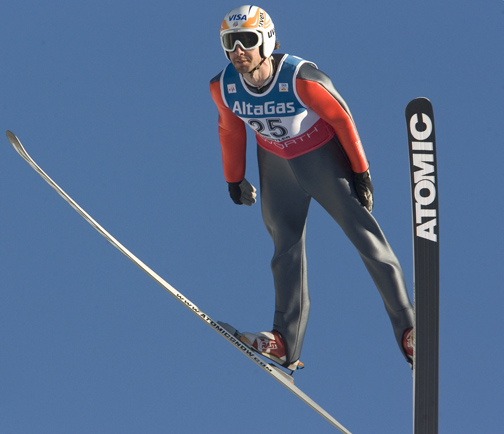 December 4, 2009 (Lillehammer, NOR) – Sitting out the first Nordic Combined World Cup in Kuusamo, Finland was just the ticket for Johnny Spillane. He placed second on Friday in the ‘pocket jump’ round of jumping on the big hill in Lillehammer, NOR, going into tomorrow’s World Cup event. Spillane’s team mate 2009 World Champion, Billy Demong was 22nd, and Brett Camerota was 46th. Todd Lodwick won’t join the team until the circuit reaches Ramsau, AUT – see full results below.
The ‘pocket jump’ provision was added by FIS last year. All NC individual competitions (normal/big hill jump, followed by a 10km Nordic freestyle race with race start times based on the jump standings) are on one day and most are on the big jump. Wind often makes it a challenge for organizers to keep the jumps both safe and fair. Since all FIS competitions require official training the day before, to get used to a facility, they decided to score one round of jumping and ‘put it in the pocket’, in case they needed to use it to start the Nordic race the following day.
There are other provisions being considered by FIS, and many remain undecided as to their feasibility. Currently, five judges score each jump, with the normal points per meter and 3-5 judges scoring for style. The traditional scoring, the Gundersen method, translates the jumping scores into seconds behind the winner. The winner of the jump is then the first to start the 10km xc ski race, with 2nd place starting behind him, based on his jumping score.
Now, however, this traditional calculation adjusts everyone’s score by two additional factors. The first is what gate they started from (how high up the in-run) so the officials can change gates mid-competition and not restart. And they adjust for wind by measuring the precise wind speed when the jumper is in the air and factoring each jump depending if it was a head wind or tail wind.
In one competitor’s opinion, “That’s like saying it started snowing half way through the 50km race so we will take some time off the xc skiers who started later.” But, if rules like these become too confusing to the spectators, and more importantly, television and media, they are unlikely to succeed.
Full results here.

- News
- BLOGS
- Adele Espy
- Alberta World Cup
- Alex Harvey
- Cailtlin Compton
- Craftsbury Green Racing Project
- Devon Kershaw
- Drew Goldsack
- Haley Johnson
- Holly Brooks
- James Southam
- Jessie Diggins
- Johnny Spillane
- Kikkan Randall
- Liz Stephen
- Lowell Bailey
- Perianne Jones
- Reese Hanneman
- Sadie Bjornsen
- Stefan Kuhn
- Tim Burke
- Torin Koos
- Videos
- Destinations
- Interviews
- Calendars
- Galleries
- Gear
- Racing
